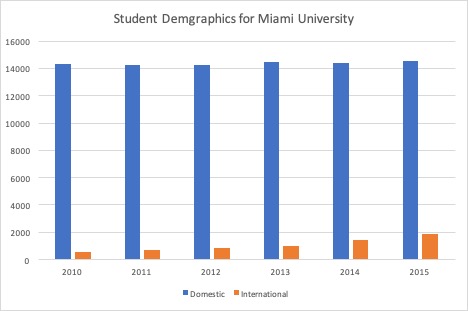
With growing number of international students, Miami University’s revenue increases proportionally. However, a section of the international student population still struggles to support their college expenses. The financial aid allotted to them reduces the economic burden to some extent, but it is not enough to help with the other expenses such as text books, rising rate of housing in Oxford.
Nikita Vadhani is an international student from India, a sophomore majoring in Engineering. She faces similar struggles which makes her time at the university difficult.
Vadhani is currently receiving a financial aid from the university. However, she still has to pay a lot for other necessities of the college life. “It is tough to manage the expenses,” she said, “There are many things that come up and have to be paid for, and the money conversion rate makes it more difficult to afford it.”
Along with talking 18 credit hours each semester, She has two on-campus jobs. She considers this an earning opportunity so that she can help to reduce the financial burden on her parents. However, she also expresses her dissatisfaction for the employment at Miami University.
“Firstly, according to the rules, international students can only work 20 hours per week which limits the opportunity. Secondly, most of the university jobs are paid at the lowest wage rate of $8.1 per hour. Also, being an international, I cannot work off campus where the wages are high. All such factor, whether national laws or university facilities, puts a limit on earning.” said Vadhani.
She strongly feels that if the university admits more international students each year, they should also consider these factors and make provision to better the situation. “I understand that the ongoing stereotype about international students being ultra-rich is around, but everyone needs to understand that that is just a small section of us while majority of us belong to the normal middle class families,” Vadhani added.
Molly Heidemann, Associate Director of the International Student and Scholar Services (ISSS) agrees with Vadhani’s concern. “It’s true that numbers of international students have certainly increased a lot. Since I have been here which is the past 8 years, there has been a dramatic increase. When I started in fall 2008 we had only 550 international students while now we have 2800 university wide international students, with about 2500 here in oxford campus itself,” Heidemann said.
In 2016, Miami University’s Oxford campus hails undergraduates from 87 foreign countries and graduate students from 51 countries. This number is approximately 8.4 percent of the total incoming student population in that year.
According to Heidemann, the admissions office decides the number of international student admitted and also is responsible for their selection criteria and financial aid allotment. The ISSS office works on the student’s visa and legal matter while the Office of Employment is responsible for the wage rate and related factors. Heidemann also adds that the problem arises as these department lack in knowing the responsibilities of each other.
“All of us have our own restriction. We cannot legally allow students to work off campus. The exchange rate is something that cannot be controlled. The Office of Employment might have their own budget or process for wage allotment that they must follow while the Admissions Office also might have similar goals and limits,” said Heidemann.
However, this does not ease the student struggles. Over the past years, Miami University’s tuition cost has also increased drastically. The data from Office of Institutional Research (OIR) at Miami University suggest that there has been an increase of 2.9 percent in tuition cost since previous year. The trend also present a similar upward going pattern.
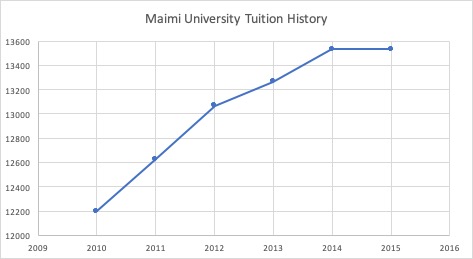
The raising tuition cost of Miami University, however, does not align with the financial aid allotment statistics. The data from OIR also presents that 72 percent of the total incoming student population filed a Free Application for Federal Student Aid (FAFSA) in the year 2016. However, the allotment of FAFSA is not distributed proportionally to the in-state and out-of-state students.
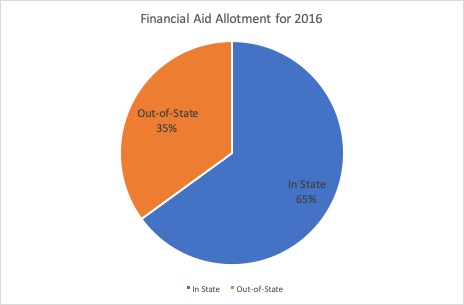
International students fall under the category of out-of-state students and hence their scholarship are relatively much less. The share also gets lower if other additional costs are added such as health insurance and legal fees which only imply to the international students.
There is a need for Miami University to address this issue. Not just Vadhani, but most of the international student population struggles with the same issue. Miami University earns a lot of revenue from its international student population but in return they lack in providing equal earning scope.
According to NAFSA’s International Student Economic Research, Miami University stands 3rd in position for earning most from its international students. Miami University earned about $90 million in the academic year of 2016. However, this number just supported a total of 1326 jobs which was very less compared to its total international student population.
The data also presented that Ohio State University topped the list by earning $208 million supporting 3122 jobs. University of Cincinnati also placed itself ahead of Miami university by raising $105 million while supporting 1493 jobs.
The national statistics on the topic suggest that during the academic year of 2016, $33 billion was contributed by the international students. This amount was successfully able to support about half million jobs throughout the U.S. Likewise, for every seven international students admitted to a U.S. college or university, three jobs were created nationwide.
The data along with the student experience suggest a need for Miami University to reconsider its international student population. The national laws for the international students cannot be changed but the university policies on the topic could help make student life better.

 Rasika Rane