Walking around Washington square in New York City, you are most likely to notice the purple and white upheld torch logo in the surroundings. The city marks itself as the top metropolitan area for international students, while New York University hosts the largest number of international students in the United States.
For the fourth year in a row, NYU has ranked No.1 in enrollment of international students from across the globe according to the 2017 Open Doors report released by the Institute of International Education. However, the changing perspective of the country towards immigrants and the president’s stance on migration policies have not spared the university from its aftereffects. Growth in international student enrollment at the university has slowed down, and now — like many colleges nationally — NYU is fighting to keep its global reputation as a hospitable destination for international students.
The school’s efforts point to a way forward as colleges across the United States struggle to maintain or grow their ranks of international students.

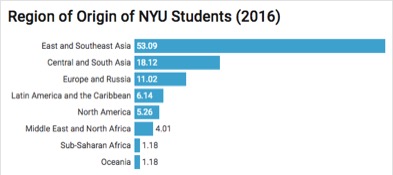
In the 2016-17 academic year, NYU attracted 17,326 international students, a 11.5-percent increase over the previous year. However, a reduction in percentage change has been observed , which is emblematic of the decreasing enrollment rate throughout the country, after the 2016 presidential election results.
The percentage change of international student enrollment came down to 2.4 percent from 8.8 percent in Fall 2015, and further dropped to -3.4 percent in 2016.
NYU’s success in creating a global network of scholarship has been cited by the Institute of International Education, the National Association of Foreign Student Advisers and U.S. Department of State’s Bureau of Educational and Cultural Affairs.
“As our mission states ‘We strive to create an innovative and empathic environment’,” said Sherif Barsoum, Associate Vice President of the Office of Global Services at NYU. “We keep this as the basis of every action and initiative we create, as we comfort our international population in times of apprehension due to external factors.”
The school’s efforts include personalized immigration, visa, and intercultural services, Barsoum said, as well as programs that respond to the needs of students and their families and promote cross-cultural understanding.
According to Barsoum, NYU has largely managed to shield itself from the effects of the anti-immigrant political environment, in part because its student body is already so international
Abhinish Popli, a computer science engineering graduate student, was enrolled during the transition of presidency. He arrived from India in August 2016 when the tension regarding acceptance and inclusivity was at its peak.
Popli said he was worried that the classroom culture might be hostile, or perhaps that his fellow students wouldn’t accept him socially. He also didn’t know if he would be able to find work after he graduated.
But the university’s active approach to making students feel comfortable and supported helped a lot, he said, “I probably wouldn’t be so comfortable otherwise.”
Popli also mentions examples of student studying elsewhere in United States who did not receive such support. He recalls an incident where his friend, studying in one of the central states, was verbally abused, criticized for having ‘stinky food’ in public, and was told to ‘go back’. The authorities didn’t respond well and simply asked her to beware of her surroundings and stay at safe places around and on campus.
“I think it is really the university who has to make the student feel secured,” Popli added.
The travel ban was the scariest incident, he said and that made the students of NYU realize the value of support that they have. There were various immediate actions taken to ease the students emotionally and practically.
“Apart from the workshops, orientation, support groups and socials, an essentially unique initiative we host is the NYU Know Your Rights Project,” said Malissa Zuroff, Associate Director of Communications and Outreach at the Office of Global Services at NYU, who has been active in leading and promoting the program.
The rights for U.S. citizens and permanent residents are not the same as rights for people in non-immigrant statuses such as F-1 and F-2 or J-1 and J-2. These visa categories are intended for people who enter the U.S. for academic purpose, for short term, and hence, are bound by rules regulating their time and actions in the country. They have restricted employment opportunities, greater risk of deportation, and similar other factors that differ from a local citizen.
According to Zuroff, it’s important for the students to be aware of the rights they have as an international student or scholar. The knowledge of these rights is required, especially in times of uncertainty related to the country’s migration policy.
The NYU Immigrant Defense Initiative and the Office of Global Services partnered to create the NYU Know Your Rights Project, providing Know Your Rights presentations on-campus and in the community. The on-campus presentations are a series of workshops that addressed issues such as policy changes regarding to migration and employment, U.S. international relationship with other countries and major current events that could affect students and staff across NYU. NYU might be the unique case of hospitality that offers secure experience to its student, but it is an example of how initiatives from the educational institutions help in maintaining the diversity and inclusivity in campuses across U.S.

 Rasika Rane