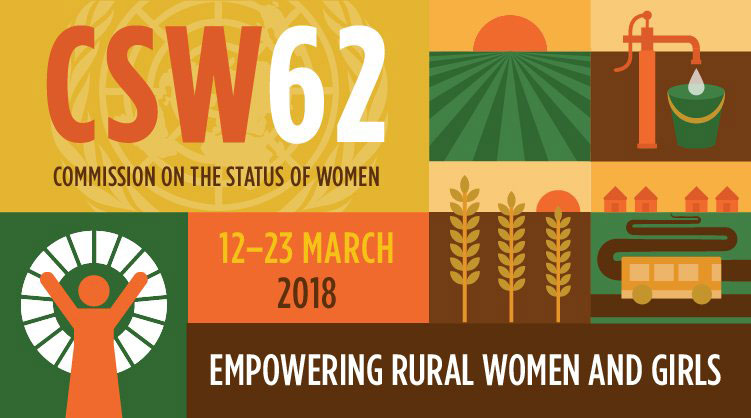
In a room full of women at the United Nations discussing empowering other women in rural areas around the world, two men were in attendance, perhaps a symptom of the problem.
The one male panelist at the discussion in March was Uldrick Gaillard, president and chief executive officer at, the NGO Batey Relief Alliance. Gaillard stressed that male involvement was essential in solving inequities faced by rural women and girls and that empowering the whole community is the key. The other male there was in the audience of 112 women.
“Rural areas are male dominated and have very male dictated societies,” said Gaillard on men’s role in contributing for women empowerment. “Therefore, raising awareness in men and boys, encouraging them to involve and attend to women’s issues is half of the women empowerment, as they are the rest half of the society.”
Gaillard represented his organization at the Commission on Status of Women panel discussion on effective partnerships and proven approaches that help rural women and girls overcome poverty and build sustainable futures for themselves and their communities. Other panelist included Jo Sanson, director of Monitoring, Evaluation, and Research at the NGO, Trickle Up; Rocio Ortega, program associate at UN Foundation’s Girl Up, Lindsay Cope, associate director at Village Enterprise; and Erin Anastasi, coordinator at UN led Campaign to End Fistula.
Ulrick Gaillard’s initiative is an international non-profit humanitarian organization founded in New York in 1997. Its mission is to provide health services, education and development programs in the rural areas of the Caribbean and the Americas by providing health services, education and development programs, including the Dominican Republic and Haiti.
Gender equality is at the very heart of human rights and United Nations founding principles. A fundamental principle of the United Nations Charter adopted by world leaders in 1945 is “equal rights of men and women,” and protecting and promoting women’s human rights is the responsibility of all States.
As a majority audience opinion of the panel, speaking up for women’s rights is necessary now as the world becomes more unpredictable and chaotic. Even in the United States, alarming concerns have been in discussion pertaining to women’s issues. “It’s not just Donald Trump who needs to be better,” responded an audience member as she agreed to Gaillard’s’ notion on participation of men for women empowerment.
An overwhelming majority of Americans—93 percent—believe in the importance of working toward gender equality, and 80 percent think there is still work to be done, according to a survey in 2017 called the State of Union on Gender Equality, Sexism and Women’s Rights, conducted by PerryUndem Research in 2017.
Historic imbalances in power relations between men and women are leading to greater discrimination against women and girls. Tradition, cultural values and religion are continually being misused to restrict women’s rights, linger sexism and defend misogynistic practices around the world.
Majority men often carry the perception that women’s rights are important because everyone is birthed by women, or because they have family and friends that are women. This is a deeply problematic approach, which ties women’s value to the men in their lives. The fact that women are human beings, who make up half of the global population, should be reason enough.
While the participation of men and boys is essential to end the negative effects of patriarchy and gender-based inequality, men have been typically removed from discussions on these issues. Working with men and boys to transform harmful gender norms and unequal power dynamics is a critical part of the solution to achieving gender equality. For the empowerment of women and girls to continue advancing, men and boys must see themselves as allies in the process.
In some cases, the old ideals of masculinity constrain men as well, and working for gender equality and women’s rights would free all genders from these ideals. Equal treatment for women will lead to equal treatment for men. In a truly gender-equal society, men would be able to raise families, pursue their careers, or combine the two without judgment.
Various international organizations have taken charge and are dynamically acting in changing making this happen for betterment of the society.
UN Women is the biggest influential player in this process. Their work on engaging men and boys for gender equality is anchored in the belief that achieving gender equality is about transforming unequal power relations between men and women. This involves challenging notions of masculinity and traditional perceptions of manhood. It requires men to question power dynamics in their actions or their words at the personal, interpersonal and societal level and to take responsibility for change. UN Women seek to take the issues of men, masculinities and gender equality to and beyond the academic, activist and research domains.
“Gender equality can only be achieved if men and boys take full responsibility, working side by side with women and girls, to redress the dynamics that hinder progress,” said Phumzile Mlambo-Ngcuka, UN Women’s executive director, in her speech at the 2014 Global Symposium for ‘Men and Boys for Gender Justice and has been reiterating every year since then. “Men need to be engaged as gender advocates – speaking out as active agents and stakeholders who can transform social norms, behaviors and gender stereotypes that perpetuate discrimination and inequality,” she added.
In her speech, Mlambo-Ngcuka also said, “From an early age, boys are socialized into gender roles that keep men in power and control. Many grow up to believe that dominant behavior towards girls and women is part of being a man. Systematically changing this narrative is important.”
UN Women recently appointed Indian actor-filmmaker-singer Farhan Akhtar as its South Asia Goodwill Ambassador. He is the first man to be chosen as a Goodwill Ambassador in the organization’s history. He has previously represented the voice of numerous concerned men on the important issue of gender equality and violence against women and girls in India through his Men Against Rape and Discrimination campaign, smartly abbreviated as MARD that literally means ‘man’ in Hindi which itself goes against the stereotypical notions of masculinity and instigated the progressive approach.
“Violence Against Women and Girls is a shameful violation of human rights that our nation should not and must not condone. I call upon our youth to participate and create a new age of dialogue on the subject of gender violence,” said Akhtar in a media statement while announcing his new role in 2014. “I hope such solidarity will grasp the attention of our nation and its leaders. I implore the leaders of tomorrow to be the change today and proactively participate in this campaign,” he added.
As a goodwill ambassador, he will dedicate his efforts to the empowerment of women and girls, and will serve as an advocate for UN Women’s newly launched HeForShe initiative in advocating for gender equality.
According to the UN, HeForShe is another initiative that has spurred citizens around the world to sign up to do their part for gender equality and women’s rights. From the classrooms to the streets, local leaders and everyday male citizens, are addressing violence against women and redefining masculine identities through community intervention programs and education.
Complementary to these global level initiatives are several programs in specific countries that have exceptionally succeeded in their attempts to raise awareness among men for women empowerment, especially around preventing rural women against violence.
Here are some examples of programs that get men involved in gender rights.:
— In Rwanda, men’s Resource Centre is a local organization by a group of Rwandan men who wanted to engage men in gender issues and promote ‘positive masculinity’, encouraging men to be loving, caring fathers and partners who are supportive of gender equality and women empowerment. The organization educates and mobilizes communities to reject violence and redefine masculine identity. They have trained over 3,000 leaders, highly influential men and women elected to local government at all levels, on gender-based violence.
According to Edouard Munyamaliza, the executive secretary of the organization, many men engage in negative masculinities, and violence, because they fear social punishment. A positive, non-violent understanding of masculinity is the starting point toward fighting gender-based violence. Only then, men can be engaged to oppose harmful traditional norms or practices.
— In Dominica, a violence-prevention program helps boys overcome gender stereotypes. UN Women’s Caribbean Office have developed a community intervention program for teenage boys that is challenging gender stereotypes while teaching teens about building healthy relationships, as a preventive strategy to reduce the rate of violence against women.
— In Turkey, fatherhood training programs are in action to end discrimination against women. AÇEV Mother Child Education Foundation in collaboration with UN Trust Fund to End Violence against Women, aims to prevent domestic violence by involving men as allies in the issue, and promoting gender sensitivity and equity among fathers. Through a three-month curriculum of weekly meetings, members share their experiences as fathers and discuss often unfamiliar topics, from how to improve listening skills and manage anger, to the way that violence is often rooted in gender stereotypes.
— The HOPEM Men for Change Network is cooking up change in Mozambique. HOPEM’s Men in the Kitchen program promotes gender equality and addresses violence against women and girls by increasing men’s participation in domestic activities. The program combines dialogue and reflection on gender-related topics with workshops on nutrition, education, and cookery. As part of the campaign, the organizers use a mobile kitchen to arouse curiosity, then attract observers with artistic activities such as poetry, music and theatre, or by initiating debates on gender issues.

 Rasika Rane