The United States has long been considered the hub for international education, an arrangement that has benefited both international students and U.S. colleges and universities. But for the first time in years, there has been a slowdown in new international student enrollment, and experts suggest this is likely the impact of Trump administration immigration rhetoric. Students increasingly say that fear of a hostile environment, and potential visa troubles, are making them think twice about studying in the U.S.
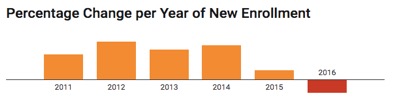
According to the Open Door 2017 report and International Student Enrollment Survey by the Institute of International Education, enrollment rates have declined for the first time in the past 12 years. Although, U.S. colleges and universities hosted a record-breaking 1.08 million international students, there has been a growth of just 3.4 percent compared to increases from the previous years, a significant slowing of growth.

And, perhaps more troubling for higher education, for the first time in a decade, institutions report an expected drop in enrollment of new students — nearly 7 percent in Fall 2017. Though it’s too early to know for sure whether the trend will continue, the flattening in the number of new international students clearly began two years ago, coinciding with Trump’s announcement of candidacy on June 16, 2015.
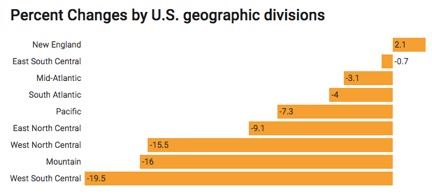
The drop in new international student enrollment patterns also differ geographically across the top host states and U.S. regions. While New England has managed to maintain its status as a preferred destination for international students, other regions of the country have seen significant declines in the number of international students enrolled. In the region that includes Texas and Louisiana, the number of students has dropped by the staggering figure of nearly 20 percent.
The University of Texas and Texas A&M are the top institutions that are affected.
Mohit Gupta is an international graduate student from India who started attending University of Texas in Fall 2017. “At first, I was resistant about the attending as I had heard negative incidents in the area, but admission to my program was a priority for me, said Gupta. “I would have definitely preferred some place in the east or west coast if I’d had the option to.” California and New York institution also indicate declines, although their decreases are smaller than the national average of 6.9 percent.
Uncertainty plays a large role in the admission patterns of the recent year. The context is the widespread concern among colleges that large numbers of prospective international students might stay away from the U.S. due to perceptions of a less welcoming climate toward immigrants and international visitors.
Among institutions already experiencing the effects on enrollment, a notable shift occurred in many of the reported reasons for falling international student rates.
Visa application process issues or visa delays/denials is the top reason for drop according to the data. The percentage of institutions citing this issue grew by 35 percent in the past year. A significant proportion of students also mentioned that the U.S. social and political environment and feeling unwelcome are also the factors that they are concerned about. The student concerns can be better observed through their region of origin as it shows a noticeable pattern of their thought process.
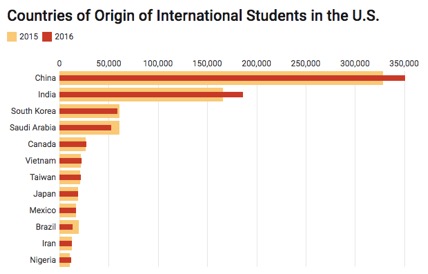
About half of all international students hailed from China and India. Chinese and other Asian students, excluding India, are mainly concerned with post-graduation employment opportunities and program affordability. Indian students have a high level of concern about the safety of potential study in the United States. A majority said they were worried about being physically safe.
Yidan Zhang is a senior undergraduate student at Miami University who is worried about her immigration status after graduation. As a business major, she is still trying to secure an internship or a full time employment as a recent graduate, but facing several issues related to the scenario.
“As an international student in this uncertain time, it is very difficult to find a job. I have had employers who like my resume and want me to work for the company, but tell me that they can’t hire internationals as they’re not sure when and how the regulation might change,” said Zhang. “They don’t want to risk their resources, but we as students end up losing our careers, efforts and finances that we spent for the quality education.”
Ashutosh Khatri from India, Yan-Ting Cheng from Taiwan, Suni Lan Nguyen from Vietnam, and many other student have the same concerns.
Middle Eastern students expressed many concerns including securing and maintaining a visa status and feeling included in the culture. The ‘travel ban’ targeting Muslim countries sent many students of that faith into a panic.
Kasaf Shah is an international student from Lahore, Pakistan, currently residing in New York. She recalls the week of ban as her most terrifying experience in the United States so far. Although she wasn’t directly affected, there was a constant fear of forceful detachment, either from home or from her career and education.
According to her, the situations have eased since last year, but the effects can still be felt in the behavior and treatment of people. “The instantaneous consequences are manageable, but the aftereffects are the toughest to deal with,” said Shah. “You can feel the difference in the way a cashier will treat you at grocery shop counter verses how he or she will greet others surrounding you.”
“Even if it is outside the educational sphere, such instances feel awful and directly impact your experience as an international student living in this country,” Shah added.
Many students have experienced a similar shift in approach towards them. Kishan Gajjar is an international student at Stevens Institute of Technology who is upset about the inclusivity when it comes to academic progress. He mentions that the difference is evident when working on group assignments and projects. “There is diversity in students but they don’t always blend with each other. You will often find that American students have one group, Chinese students have other, and we Indians have our own,” said Gajjar. “I was expecting an environment more like the ones pictured in the brochures, but [the reality] is slightly off.”
Complimentary to the students concerns, institutions are also facing related issues. The highest level of institutional concern is regarding enrollment of students from the Middle East, followed by India.
However, institutions are responding to the shifting social and political situation through multiple forms of outreach to the university campus and broader community, so as to minimize the distress and promote the internationalization of education. Many institutions report working closely with international students on campus by conducting awareness programs about changes in U.S. policies, creating opportunities for international students to engage in or discuss events happening around, and providing counseling and mental health services to those with severe concerns. Many institutions are also openly advocating for international students by issuing public statements supporting international students on campuses and releasing new social media campaigns.

 Rasika Rane